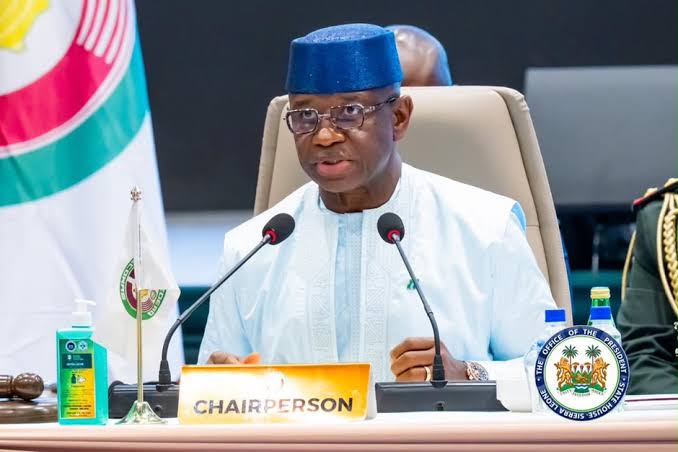
This week, between July 12 and July 19, Sierra Leone steps onto the center stage of West African diplomacy as it hosts the 69th Ordinary Session of the ECOWAS Authority of Heads of State and Government. The summit, will mark the largest gathering of regional leaders in the country since the OAU Summit of 1980, and for President Julius Maada Bio, it represents a defining moment of his stewardship as current Chairman of the ECOWAS Authority.
The summit signals a monumental narrative pivot. It serves as validation of Sierra Leone’s contemporary stability and a direct acknowledgment of President Bio’s growing influence in regional statecraft.
The eight-day diplomatic blitz is structured around a series of statutory meetings culminating in the main Heads of State gathering on the 19th.
Sierra Leone’s Minister of Foreign Affairs and International Cooperation Alhaji Musa Timothy Kabba said all West African presidents are expected to attend, alongside foreign ministers, development partners, and representatives of accredited international organisations. He had embarked on a diplomatic blitz aimed at whiffing confidence and interest in member states.
The logistical epicenter of this diplomatic offensive is Lungi, historically regarded as the gateway to Freetown’s international airport. Under President Bio’s direction, the area has been rapidly transformed into a permanent diplomatic citadel.
The newly constructed Julius Maada Bio International Conference Centre and a network of luxury presidential villas sit opposite the Freetown International Airport, offering visiting delegations direct access without the need to cross the estuary by boat or ferry, a first for a summit of this magnitude in Sierra Leone.
President Bio will officially commission both the conference center and the ECOWAS Logistics Depot on 18 July, assets designed to outlive the week long event and position Sierra Leone as a future hub for regional and international conferences.
Unlike the 1980 OAU Summit, where infrastructure was largely financed through direct government expenditure that depleted the country’s foreign reserves, the ECOWAS 2026 facilities have been developed through a Public Private Partnership (PPP) with FB Group ULUSLARARASI YATIRIM VE DIS Ticaret Anonim Sirketi. This arrangement reduces immediate fiscal pressure on the government of Sierra Leone.
President Bio has described the security situation in West Africa in realistic terms. More than half of all terrorism-related deaths worldwide now occur in the region, with armed groups no longer merely testing states but actively seeking to dismantle them. He has warned that fragmented and reactive responses are no longer acceptable, calling for intelligence sharing, mobility, logistics, and coordinated operations as essential, not optional.
The summit will address the rising wave of insecurity across the region, including diplomatic initiatives aimed at engaging the military juntas in Mali, Burkina Faso, and Niger, while navigating the emergence of the Alliance of Sahel States (AES) as a competing regional bloc.
Beyond security, the summit will tackle the compounding economic challenges facing the region. President Bio has emphasised that citizens are no longer waiting for promises. They want tangible results – jobs, economic opportunity, and regional integration that functions in practice, not just on paper.
The West Africa Integration and Investment Summit (WAIIS 2026) track, developed through months of expert planning, focuses on four strategic pillars, that is energy trade, strategic minerals, agribusiness, and digital transformation. The aim is to move beyond ceremonial rhetoric toward implementation-driven, business-led regional integration.
Notably, Sierra Leone has already demonstrated its digital ambition by hosting the West Africa Internet Governance Forum (WAIGF 2026) in Freetown in May, as well as the 20th Meeting of ECOWAS Ministers in charge of Telecommunications and ICT. These preparatory gatherings signal a regional shift towards digital sovereignty, cybersecurity coordination, and the development of a unified digital market across West Africa.
In his last and final term, President Bio is clearly aiming to cement a legacy of regional leadership. His tenure as ECOWAS Chairman has been marked by efforts to restore democracy in neighbouring Guinea and to strengthen democratic norms across coup-prone areas of West Africa, especially in the Francophone and Lusophone blocs. The 2026 ECOWAS Summit is not merely a diplomatic event. It is a reckoning with Sierra Leone’s past and a bet on its future. The ghost of 1980 looms large, but President Bio has framed this gathering as a different kind of legacy. It’s a legacy built on transparency, regional cooperation, and a vision of West Africa that secures his place amongst the best in the diplomatic world.